Summer Camp Guides
How to Get a Summer Camp Job: Requirements, Timing, and Applications
How to Get a Summer Camp Job: Requirements, Timing, and Applications
Landing a summer camp job can be different from finding other seasonal work. Camps may start hiring months ahead of the summer. Your availability and, in some cases, where you will be living or how you will get to camp can affect whether a job is workable. Some roles require certifications before the season begins, and references or background checks may also be part of the hiring decision.
This guide walks through the hiring process from requirements and timing to applications, screening, interviews, and evaluating an offer. If you are still deciding what kind of job you want, start with Types of Summer Camp Jobs: How to Choose the Role That Fits You. If you are not yet sure whether camp work is a good fit for you, see What Working at a Summer Camp Is Actually Like. If you already know what you want, browse the Camp Channel job board.
What Camps Require Before They Can Hire You
When a camp describes a position, it may state both requirements and preferred qualifications, and the two are not always distinguished. Requirements are conditions you must meet. Preferred qualifications can strengthen an application without determining whether a camp is able to hire you.
Requirements can include:
- Minimum age. Camps set their own minimums, and they can differ by role within the same camp, so check the minimum for the particular position.
- Credentials held before the season. Some positions are built around a certification, and a camp may require it to be in hand before it can place you in that role. Which categories of position work that way, and which run on demonstrated skill instead, are covered in Types of Summer Camp Jobs: How to Choose the Role That Fits You.
For other qualifications, the wording is the clue. “Must have,” “required,” and “prior to start” point one direction. “Preferred,” “a plus,” and “willing to train” point another. When the wording leaves it unclear, ask the camp which qualifications are required.
Requirements do not all appear in the same place, or at the same time. Some are stated in the job listing, some on the camp’s employment page, and some may not appear until the application itself. If you are unsure whether you meet a requirement, find out before spending substantial time on the application.
What Camps Are Looking For
Meeting the requirements for a position does not make you a strong candidate for it. Requirements determine whether you can be considered at all. Everything after that, from the application through references and the interview, gives a camp ways to assess qualities that do not fit neatly on a checklist: reliability, judgment, and how you handle responsibility.
How much weight a camp places on each of those qualities, and what it treats as evidence of them, varies by camp and by position. Ask a camp what it weighs most heavily when it fills a particular position.
Because a camp is weighing those qualities rather than working down a checklist, relevant experience does not have to be camp experience. Any setting where you have been responsible for children, or for a group, is something a camp can evaluate:
- Coaching, refereeing, or assisting with a youth team
- Tutoring, teaching, or classroom assistance
- Childcare, babysitting, or care for younger family members
- Scouting, youth group, faith community, or club leadership
- Volunteering with a program that serves children
- Any job where you were trusted with equipment, money, or the safety of other people
None of those settings is a qualification by itself. Each camp decides what background matters for a particular position, so include the experience that connects most clearly to the role.
Program fit is the other half. A wilderness expedition camp, a competitive sports program, and a performing arts day camp are not necessarily evaluating the same things, even when the position carries the same title. Focus on how your actual experience fits that particular program instead of presenting yourself as a generic strong candidate.
When Camps Hire
Camps build a staff around fixed season dates, and some begin hiring for the next summer as early as the fall, which can put the application many months ahead of the job itself. Returning staff may go through a separate and earlier process, so some positions may already be filled before hiring opens more broadly.
A camp may be fully staffed for some jobs and still accepting applications for others. If it is not clear what remains open, ask which positions are still available.
Not every opening is publicly advertised. If there is a particular camp you want to work for, check its employment page or contact it directly.
If you are searching well into the spring, your approach may need to change. Late Season Options and Strategies For Finding Summer Camp Jobs looks specifically at that stage of the search.
Where Camp Job Openings Appear
Seasonal work at summer camps turns up in several places, online and through direct contact.
- Camp job boards. These gather openings from many programs in one place, so you can compare locations, program types, and kinds of work without checking camps one at a time.
- Camp employment pages. A program’s own website may carry positions or hiring details that appear nowhere else.
- Camp fairs and campus recruiting events. Where they are available, these give you a chance to speak directly with the people doing the hiring rather than starting with an application.
- People who have worked at camps. Former staff may know whether a program is hiring, who handles staffing, and what it is like to work there.
- Placement and staffing organizations. Some organizations connect applicants with camps. Check what they provide, what they expect from you, and whether any fees or commitments are involved before signing anything.
The Camp Channel job board lists current openings at camps across the country and can be filtered by camp type, camp gender, program emphasis, and state, including a filter for camps serving campers with disabilities. You can also let camps find you: the Camp Channel resume database lets directors browse candidates and contact you directly. Submission is free, with a minimum age of 18.
Applying
A camp application may ask questions you would not encounter on a standard job application, and some can determine your eligibility for the position. Depending on the camp and the role, that can include whether you are available for the full season and staff training, and whether you can get to the camp or to other locations the role covers.
Camp Channel’s own staff resume form collects some of the same information: availability dates, preferences about camp type and setting, where you intend to live during the season, the level of responsibility you are seeking, self-rated skill levels across activity areas, certifications held, education, and work experience.
Camp sessions have fixed start and end dates, and staff training may begin before campers arrive. Give your actual availability dates when you apply rather than assuming a camp can accommodate a partial season.
If you apply to more than one camp, keep a simple record of where and when you applied and the status of each application. Hiring timelines differ, and responses may not arrive in the order you applied.
If you have not heard back, a brief follow-up can confirm your continued interest and availability. Silence by itself does not tell you where an application stands.
References and Background Checks
Camp hiring can include reference checks, background checks, or other screening. A camp placing an adult in a position of trust with children is accountable to families for that decision, and in some cases to a state agency or an accrediting body. What is required depends on the camp, the position, and where it operates. Ask what the screening involves, when it happens, and what the camp needs from you.
A camp may also ask for references. Choose people who have seen you handle responsibilities relevant to the job. Depending on your experience, that might be a coach, a teacher, a volunteer coordinator, or a supervisor rather than your most recent employer.
Contact them before a camp asks. Find out whether they are willing, tell them what the position involves, and let them know a request may be coming.
The Interview
Camp interviews may happen by phone, video, or in person, and some camps interview candidates in a group or in more than one round.
Your application already sets out your experience, skills, and qualifications. The interview is where a camp hears how you communicate, think through situations, and handle responsibility.
Situational questions can be part of that. You might be asked what you would do if a camper refused to participate or if two campers in your group would not stop fighting. Explain how you would approach the situation, including when you would bring in another staff member.
The interview is also your chance to ask what a typical day looks like, how staff are supported when something goes wrong, what training happens before campers arrive, and what the camp expects of you outside program hours.
Evaluating an Offer
Pay is one question; the terms are another. Before you accept, make sure you understand four things.
- Dates and schedule. Confirm the exact start and end dates, when staff training begins and whether it is paid, and how days off work.
- The role as offered. Check which position you are being offered, the age group you would work with, and what the job involves beyond the title.
- Living and working conditions. Ask where you will sleep, which meals are provided, whether those start at training or at the first session, what the camp expects during off hours and days off, and what rules apply to leaving the property.
- What is in writing. Find out if the camp will send an offer letter or staff agreement and what it covers. If something you were told in the interview does not appear in the document, ask to have it put in writing. Resolve any unclear terms before accepting.
How to judge the compensation itself, including wages, housing, meals, and other parts of the package, is covered separately in Summer Camp Job Compensation: What to Expect in Pay and Benefits.
This post is part of the Summer Camp Jobs and Staff guide on Camp Channel.
Frequently Asked Questions
Can you apply to several camps at the same time?
Yes. Be accurate about your availability with each camp, and let the others know promptly if you accept a job elsewhere.
Do camps hire staff who are only available for part of the summer?
Some do, depending on the camp and the job. Session structure and the need for continuity with the same campers can affect whether a shorter period works.
Do you need to know someone at a camp to get hired?
No. You do not need a prior connection to be considered. Knowing someone who has worked at a camp can tell you more about the program than a listing will.
Do camps hire applicants who live far from the camp?
Yes, in some situations. Residential camps may provide housing, while a day-camp job can depend on whether you can commute to the worksite. If getting there is a concern, ask how housing works and which travel costs fall to you.

Types of Summer Camp Jobs: How to Choose the Role That Fits You
Most people thinking about working at a summer camp picture one job: counselor. Camps need far more than counselors, and job titles do not always tell you what the work involves. A cabin counselor, a waterfront instructor, a kitchen assistant, and a unit leader are all camp staff, but almost nothing about their days looks the same.
This guide covers the main types of summer camp jobs and gives you a way to choose among them. Not every position requires previous camp experience. A lifeguard certification, clinical license, or other credential can qualify you for jobs built around that training. For some activity positions, demonstrated experience matters even without a formal credential. Camps also hire people in food service, facilities, administration, and other areas that keep the camp running.
How to Compare Camp Jobs
Four things separate one camp job from another.
- Responsibility for campers. In some jobs you keep the same group of campers throughout the session. You eat with them, stay with them through the less structured parts of the day, and remain responsible for them even during activity periods you spend apart. Other jobs give you responsibility for a group only for a defined period before a different set of campers arrives. Elsewhere at camp, you may work alongside campers and share in looking after them, but supervising them is not what the job is for.
- Credentials and skills. Some jobs are open only to applicants with a specific certification or license. Others accept demonstrated ability in place of a formal credential. Many require neither.
- Camp experience. Some jobs are regularly filled by people working at camp for the first time. Others expect previous camp experience, particularly when the work involves supervising staff or making decisions that depend on understanding how a camp operates. A camp may also favor someone who already knows that particular program, its routines, and its campers. Expectations vary from camp to camp, so ask before ruling a job out.
- Where you work and who you work with. Even at the same camp, staff can spend their days in very different places. Some work outdoors almost entirely, moving between cabins, activity areas, and shared camp spaces. Others are based in one place: a kitchen, an office, a health center, or a maintenance shop. Trip staff leave the property altogether for hours or days at a time. Who you spend the day alongside varies just as much: a fixed group of campers, a new set every period, or mostly other staff.
Camp compensation can include wages, room and board, and other benefits. For more on how those components vary between positions, see Summer Camp Job Compensation: What to Expect in Pay and Benefits.
Cabin and Group Counselors
A cabin or group counselor has ongoing responsibility for a particular group of campers across the session. That includes their welfare, the routines of cabin or group life, and helping the group function well together.
General Cabin Counselor at Residential Camps
At residential camps, cabin counselors are responsible for the campers assigned to their cabin and for the routines of living together. They help manage meals, rest periods, and bedtime, and get to know the campers well enough to notice when someone needs help. During activity periods some camps keep counselors with their cabin group, while others assign them to teach or lead an activity attended by campers from different groups.
Group Counselor at Day Camps
At day camps, group counselors are assigned to a particular group of campers for the program day. They commonly stay with that group as campers move between activities, assisting while specialists provide instruction. The job has no overnight component. Counselors are also part of the daily drop-off and pickup process with families.
Assistant and Junior Counselors
Some camps hire assistant or junior counselors to work alongside their regular counseling staff. A camp may post both positions at once, with the assistant or junior position open at a younger age, carrying less responsibility, or paying less than a regular counselor position. The titles are not standardized. At one camp a junior counselor may be a seventeen-year-old who has come up through the camp’s own training program, while elsewhere an assistant counselor may be a college student working as part of a counseling team. Check what a camp means by the title before you apply.
Co-counselor is different. Residential camps often assign two or more counselors to the same cabin, with those counselors sharing responsibility for the group rather than one assisting the other.
Counselor-in-training positions may also be available to people below a camp’s staff minimum. These are developmental programs rather than staff jobs and sit outside what this guide covers, though at some camps completing one is what qualifies someone for a junior counselor position.
Camp Jobs Built Around a Skill or Credential
What qualifies you for these jobs is a certification, a license, or demonstrated ability in the activity itself.
Activity and Program Specialists
Arts, music, drama, athletics, nature, and STEM specialists teach or lead a particular program area. Campers may rotate through that area in groups, giving the specialist responsibility for different campers over the course of the day. At some residential camps, counselors also serve as activity instructors, while other programs hire staff primarily for the specialty.
Demonstrated ability often matters more than a formal credential in these jobs. A camp hiring a ceramics instructor, for example, needs someone who can run a studio safely and teach campers with different levels of experience, but there is no single certification that establishes those abilities. What counts as sufficient experience depends on the activity and the camp.
Waterfront and Aquatics
Waterfront positions cover guarding a swimming area, teaching swimming lessons, and running boating and other watercraft activities. The certification a camp asks for follows which of those you will be doing. Some camps hire applicants who already hold the certification; others train and certify staff before the season begins.
Some accreditation standards require aquatic and first aid certifications to include substantial in-person instruction, hands-on practice, and skills assessment, so an online-only credential may not be accepted. Camps may also require staff to demonstrate rescue and emergency skills in their own aquatic areas, regardless of the certification they already hold.
Trips and Outdoor Leadership
Trip leaders take campers away from the main camp property, where support from other staff is not close at hand. They make decisions about routes, weather, and the condition of the group while leading activities such as hiking, paddling, climbing, or overnight camping.
The skills and certifications a camp looks for depend on the trips it runs. Wilderness first aid, lifeguarding, paddling, climbing, or other qualifications may matter for some programs, while experience with the particular activity may carry more weight in others.
Health Center
Health center staff serve campers from across the program as medical needs arise, with responsibilities that can include routine medications, illness and injury assessment, ongoing health needs, and decisions about when additional medical care is necessary. Nursing and other clinical positions require the appropriate professional license; demonstrated skill cannot substitute for it.
Camp Operations and Support
Which functions have dedicated staff depends on the camp’s size, setting, and whether it serves meals, houses people overnight, or runs transportation.
- Kitchen and food service. Positions can include food preparation, cooking, serving, dishwashing, and kitchen management. Supervisory roles may also involve ordering supplies, planning meals, and managing other staff. Work hours generally follow meal preparation and service rather than the activity schedule.
- Facilities and maintenance. Staff maintain buildings, grounds, equipment, and sometimes vehicles. The work is physical and can take staff across the whole property rather than keeping them stationed in one place. Carpentry, plumbing, electrical, mechanical, and other trade skills may be useful depending on what a camp handles with its own staff.
- Office, registration, and camper services. Administrative staff handle enrollment records, family communication, forms, mail, and questions from campers, families, and staff.
- Transportation and driving. Drivers move campers and staff by bus, van, or shuttle for arrivals, departures, day trips, and errands. License and qualification requirements depend on the vehicle and the work involved. At day camps that bus campers to and from the program, driving can be a major part of each program day.
At residential programs, staff in these jobs eat in the same dining hall as everyone else, often live on the property, and become familiar to campers who see them day after day. Direct camper supervision is usually not their primary responsibility. The balance varies by position: a driver supervises campers in transit, food service staff may interact with them during meals, and office staff deal with campers and families as needs arise.
Supervision and Leadership
Leadership at camp ranges from supervising counselors or a particular program area to taking responsibility for the camp as a whole.
- Head counselor and unit leader. These positions oversee counselors assigned to a set of cabins, groups, or another part of the camp. Responsibilities can include scheduling, solving problems, coaching newer staff, and being who a counselor turns to when something goes wrong.
- Department and area heads. Positions such as waterfront director, program area lead, and kitchen manager combine knowledge of a particular area with responsibility for its staff and day-to-day operation.
Ask whether the camp fills supervisory positions from within, from outside, or both. The answer tells you whether a position is open to you now or is something to work toward.
Director-level positions extend beyond responsibility for a single cabin group, program area, or department. Depending on the camp, directors may oversee the program as a whole, supervise multiple areas and their staff, work with families, handle staffing and operational decisions, or share those responsibilities with other members of a leadership team.
Titles at this level do not mean the same thing at every camp. An executive director, camp director, program director, and assistant director may have very different responsibilities from one organization to another. Camp Director Jobs: Types of Director Positions and What They Involve looks at those distinctions in more detail.
How Camp Jobs Vary From One Camp to Another
- Residential versus day. A residential camp runs around the clock, so its jobs can extend into evenings, nights, and weekends in ways a day camp’s do not. Meals run all week, some staff live on the property, and someone is on duty after campers go to bed. At a day camp the work is bounded by the program day and starts again the next morning.
- Camp size. At a smaller camp, the same person may handle several kinds of work, such as maintaining the property and driving camp vehicles or teaching more than one activity. Larger camps are more likely to divide that work among specialized staff.
- Program type. A wilderness expedition camp, competitive sports camp, and performing arts day camp may use the same position title for work with different daily routines, skills, and responsibilities. What the program emphasizes shapes what staff are asked to do.
- Special needs programs. Camps serving campers with disabilities may build additional support responsibilities into familiar positions or use staffing arrangements designed around particular camper needs. Depending on the program, those can include higher staff-to-camper ratios, one-to-one support, accessible activities, or clinical staff working alongside the rest of the camp team. Roles at Special Needs Camps: A Guide to Position Types and What Each Involves on VerySpecialCamps.com covers these staffing patterns in more detail.
- Session length. At camps with shorter sessions, staff may welcome a new group every week or two, learn new names and needs, establish routines, and then start over with the next group. Longer sessions give staff more time with the same campers.
Matching Camp Jobs to Your Qualifications and Preferences
- If you already hold a relevant credential. Look for positions that require or value the qualification you have. A clinical license, a lifeguarding certification, or another recognized credential can open positions that are closed without that qualification.
- If you have a demonstrable skill but no formal credential. Activity and program positions let you use experience in areas such as athletics, arts, nature, or other camp programs. Experience performing or competing can demonstrate your ability in an activity, while coaching, teaching, or leading it shows experience helping others learn. What a camp expects depends on the activity and the position.
- If you have prior camp experience. A season already worked gives you familiarity with the daily schedule, how counselors and campers live alongside each other, and how problems are handled when they come up. That familiarity can matter when a camp is filling positions that oversee counselors, lead a program area, or help newer staff find their footing. Look at head counselor, unit leader, and department head openings as well as the position you held before.
- If you do not want camper supervision to be your primary responsibility. Kitchen, facilities, office, transportation, and other operational jobs offer work in the camp environment without making direct camper supervision the main purpose of the job.
Finding Openings by Camp Job Type
The Camp Channel Job Board lists openings at camps across the country. Camps describe their positions in their own terms rather than choosing from a standardized set of job titles, so finding the position that fits you may require looking under more than one name. A “unit leader” at one camp may have much the same responsibilities as a “head counselor” at another, while an “activity specialist” might be hired primarily to teach an activity or might also serve as a cabin counselor.
Some common terms to watch for include:
- Cabin and group counseling: counselor, cabin counselor, group counselor, bunk counselor, general counselor, and group leader.
- Activity and program positions: specialist, instructor, and coach.
- Waterfront and aquatics: lifeguard, swim instructor, swimming instructor, waterfront staff, and aquatics.
- Trips and outdoor leadership: trip leader, outdoor trip leader, and outdoor education.
- Health center positions: camp nurse, nurse assistant, EMT, doctor, and physician.
- Operations: cook, food preparation, dishwasher, maintenance, office, administrative, driver, and bus driver.
- Supervisory and leadership positions: head counselor, unit leader, unit head, program director, assistant director, and executive director.
For activity and trip positions, camps often use the activity itself as the job title: archery, sailing, ceramics, horseback riding, or environmental education. Read the full description before deciding whether an opening is right for you.
The Camp Channel Job Board lets you narrow listings by camp gender, camp type, program emphasis, and location. A dedicated special needs filter shows camps serving campers with disabilities and other special needs. Because a single camp posting may include several jobs, open the individual listing to see everything that camp is hiring for.
Camps post positions across a long hiring window rather than all at once, and the kinds of jobs still available change as the season approaches. If you are searching later in the spring, Late Season Options and Strategies For Finding Summer Camp Jobs covers what that stage of the hiring season looks like.
This post is part of the Summer Camp Jobs and Staff guide on Camp Channel.
Frequently Asked Questions
Can you work at a summer camp with no experience?
Yes. Some camp positions are open to people who have never worked at a camp before. What a camp expects varies by position, so check what a specific opening requires.
What is the difference between a camp counselor and an activity specialist?
A camp counselor has ongoing responsibility for a particular group of campers, including parts of the day outside scheduled activities. An activity specialist is primarily responsible for teaching or leading a particular program area and may work with different groups of campers throughout the day. Some camps combine the two, with counselors also teaching or leading activities.
Do camps ever hire one person for two roles?
Yes. One person may cover a group assignment along with a second responsibility such as lifeguarding, driving, or leading an activity. How those responsibilities are combined varies from camp to camp, and the title may describe only part of the position.
Are specialty camp jobs harder to get than general counselor jobs?
Not necessarily. Specialty positions may require a particular skill, experience, or certification, which limits who qualifies for them. Camps also need different numbers of specialists and general counselors depending on their programs.
What is the difference between a head counselor and a camp director?
A head counselor or unit leader typically supervises counselors and helps oversee a particular unit or part of the camp. Director-level positions have broader responsibilities that may extend across multiple program areas, staff groups, or the camp as a whole. Titles and responsibilities vary between camps. Camp Director Jobs: Types of Director Positions and What They Involve looks at director-level positions in more detail.
Can you return to the same camp in a different role?
Yes, depending on the camp and the position. You may be able to move into a different program area or take on additional responsibility, but some positions require experience, skills, or credentials you may not have yet. If you are interested in returning in a different position, ask about the possibility before the season ends or when you get in touch about coming back.

What Working at a Summer Camp Is Actually Like
Working at a summer camp is not an ordinary seasonal job. The responsibility is continuous, the schedule belongs to the campers rather than to you, and at a residential camp the place you work is also the place you live and sleep. This article focuses primarily on residential positions. Day camp roles are treated separately because going home each evening changes the experience.
How a Day at Camp Works
Your day follows the campers’ schedule rather than a shift or a set number of hours. For a residential counselor, that can mean being with campers from wake-up through lights out, with work starting before they are up and continuing after the last one is asleep.
The day alternates between scheduled activities and less structured time. Activity periods, meals, rest hour, and evening program are the parts that appear on the schedule a camp shows you. You are still working between them: moving campers from one place to the next, covering free periods and cabin time before bed, and handling the stretches when nothing is planned and twelve children still need something.
Responsibility at a residential camp does not necessarily end when campers go to bed. How overnight coverage is handled varies considerably. Some camps assign live-in cabin staff who sleep in the same building as their group. Some rotate overnight duty among staff. Some staff the night separately from the daytime team. Ask the camp how overnight coverage works rather than assuming one arrangement or another.
Schedules also differ by position as much as by camp. A cabin counselor, an activity specialist, and support staff can have substantially different days at one camp, with different start times, different amounts of time directly with campers, and different levels of responsibility once the day ends. Two people can work the same summer at the same camp and describe it differently, and both descriptions can be accurate.
The start of the season does not look like the rest of it. Before campers arrive, staff days go to setup and training. Once campers arrive, the first days of a session involve getting them settled and establishing the routine. Neither stretch resembles the mid-session days that follow.
What Being Responsible for Campers Means
Being responsible for campers includes the time between scheduled activities, not just the activities themselves.
Head counts, transitions between activities, waterfront and pool time, and any movement off the camp grounds all require knowing exactly who is where.
Situations that need a response can come up at any point in the day. Homesickness, conflict between campers, a child being left out of a group, and behavior that escalates faster than expected are among the situations you may have to handle in the moment rather than leave for later. Exactly who handles a problem depends on the camp and the situation, but the staff member who is there when it starts may be the first person to respond.
If you are the first to notice a minor injury or illness, your role is to recognize what is happening, respond appropriately, and get the camper to the health center or a supervisor rather than trying to resolve it yourself.
You work inside a reporting structure. Camps use different titles and reporting lines, with roles such as unit leader, assistant director, and program director depending on the camp. What matters is knowing who you report to and who you escalate to when a situation exceeds what a counselor should be handling independently. Camp Director Jobs: Types of Director Positions and What They Involve explains how those director roles differ and what responsibilities they can include.
You are the adult in the relationship, not a peer. That distinction shapes conduct expectations throughout the session, including in the moments when being liked and being responsible pull in different directions. In practice, that means sometimes making a decision a camper resents.
Time Off, and What It Actually Looks Like
At a residential camp, you should not assume that evenings and weekends are automatically your time off. Scheduled time off varies by camp and by position.
Being off duty on the camp grounds is not the same as being away from camp. Even during time off, being around campers and coworkers can feel different from getting some real distance. Some camps make it straightforward to leave; others are remote enough that leaving is impractical even when nothing prevents it.
Your employment dates may extend beyond the camper session dates. Some camps require staff on site before campers arrive and after they leave, so confirm your staff arrival and departure dates before comparing them with a summer class, family trip, or another job.
Before accepting a position, confirm three things with the camp: how scheduled time off works, whether it is on or off the camp grounds, and your staff arrival and departure dates. All three are much harder to change once the season is under way.
Where You Live and Who You Live With
Staff housing can range from bunks in camper cabins to separate staff quarters, with different amounts of shared space and privacy.
You live where you work. There is no commute that marks the end of the day, and no separate place to return to when the day has been a hard one.
At some camps, staff eat with campers and stay responsible for them through the meal. Other camps or positions separate staff meals from camper mealtimes.
When staff share housing, the people you work with are also the people you live alongside. That can produce close friendships as well as friction.
Room and board can be part of the overall value of a residential position. For more on how housing and meals factor into an offer, see Summer Camp Job Compensation: What to Expect in Pay and Benefits.
How Working at a Day Camp Is Different
A day camp job is not simply a lighter version of a residential one. You travel to and from camp each day, go home at the end of it, and may work within more clearly defined hours. The hours while campers are there can still be demanding. What changes is that you leave at the end of the day.
Day camp enrollment can also create a different rhythm. Some day camps let families enroll by the week or even for particular days, while others enroll campers for longer stretches or the full summer. That can affect how often you are meeting new campers and starting a group over. Ask how enrollment is structured and how much continuity to expect from week to week.
Depending on the role and the camp, you may interact directly with parents during drop-off and pickup. At a residential camp, family communication may instead go through the camp office. Talking with parents is a separate responsibility from supervising campers during the day.
Going home each day also changes the staff social experience. You may spend much of the day with coworkers without necessarily sharing meals, housing, and off-duty time with them in the same way residential staff may. For some applicants, that separation is part of the appeal of a day camp position.
That structure can suit local applicants, people with evening obligations or a second job, and anyone who wants to work at camp without living there for the season.
The Parts of the Job That Are Hard
Camp days start early and end late, and the sleep you lose is hard to make up during a session. Fatigue can make patience harder to maintain even when you are still doing the job well.
Some situations do not resolve. A camper stays homesick past the point where everyone expected it to lift. A behavior pattern persists despite repeated efforts to address it. A camper simply does not warm to you and spends the session making that clear. You have to keep showing up for that camper with the same attention and care, whether or not anything improves.
Conflict with a coworker can be harder to get distance from when you also live together. There is nowhere to go and cool off. A disagreement can follow you to the dining hall, back to the cabin, and into your time off.
You are working inside schedules, procedures, and supervision structures the camp has already established, which leaves limited room to do things your own way. If having control over your own schedule and working methods matters to you, that is worth considering before you accept a position.
What Staff Get Out of It
The job gives you practice in several different kinds of responsibility. Making a judgment call under time pressure. Handling a conflict before it gets worse. Leading a group of children who did not choose to be in your group. Keeping a schedule when a dozen people are depending on you.
You may also get to see changes in campers over the course of a session. A child who would not try an activity at the beginning may be doing it willingly a few weeks later, and you got to watch that happen.
For some people, the relationships built with other staff over a summer are part of what brings them back the next year.
Those responsibilities also give you concrete experience to describe when you apply for later jobs. How relevant that experience is depends on the position you are pursuing and how it relates to the work you did at camp. Camp employment does not by itself satisfy academic credit, clinical hour, or credentialing requirements. Those are set by individual schools and programs, so check with yours.
Signs the Job Fits, and Signs It Does Not
A residential camp job may be a good fit if you are comfortable spending much of the day around other people, sharing living space, having limited privacy, and staying patient when you are tired or surrounded by noise.
It may be harder to make the job work if you need substantial time alone each day, have obligations that require reliable evenings or weekends, want predictable working hours, or are uneasy holding responsibility for children continuously rather than during set hours.
Deciding that a residential counselor position is not right for you does not mean camp employment is not right for you. Day camps, support and operations positions, and different types of camps can offer very different working environments.
If you are considering working at a camp that serves campers with disabilities, What It Means to Work at a Special Needs Camp on VerySpecialCamps explains what can be different about the roles, training, and day-to-day experience.
If you want to see what is open, you can browse available listings on the Camp Channel job board.
This post is part of Summer Camp Jobs: Staff Roles, Hiring, and Compensation on Camp Channel.
Frequently Asked Questions
Do camp counselors sleep in the same cabin as the campers?
Some residential camps assign counselors to sleep in the same cabin or bunk as campers. Others house staff separately. Where you sleep does not necessarily determine how overnight responsibility is handled, so ask the specific camp about both before accepting a position.
Can camp staff use their phones at camp?
Phone policies vary by camp. A camp may limit phone use to off-duty time, restrict it around campers, or set particular times or places where staff can use their phones. Cell service can also be limited depending on where the camp is, so ask about both the phone policy and connectivity before the season begins.
Do you have to be athletic or outdoorsy to work at a summer camp?
Not necessarily. A general counselor may need stamina for an active day without being an athlete, while positions in activities such as waterfront, climbing, riding, or wilderness trips may require specific skills or credentials. Check the requirements for the particular position rather than assuming every camp job asks for the same abilities.
Can staff leave camp on their time off?
Staff may be able to leave camp during scheduled time off, but distance and transportation can affect how practical that is. If getting away during time off matters to you, ask how far the camp is from the nearest town and what transportation is available to staff.
Can staff leave camp during the summer for a wedding or other commitment?
A camp may be able to work around a known date, but you should not assume it can. If you have a wedding, family event, or other fixed commitment falling inside the season, raise it before you accept the position and get a clear answer.

The Benefits of Summer Camp: What Children Gain From the Experience
Summer camp gives children something the school year rarely does: extended time to develop independence, build genuine friendships, and engage with the world without a screen mediating the experience. The case for camp is not sentimental. It is practical, and it is well documented.
Independence and self-reliance
At camp, a child wakes up, organizes their day, keeps track of their gear, and navigates the social dynamics of shared living without a parent available to smooth things over. The structure is supervised, but the day-to-day decisions belong to the camper. Campers practice independence every day, in situations that are meaningful but not risky.
When a disagreement arises in a cabin, the first resource is the camper themselves, then their peers, then a counselor. Without parents involved in the moment, children learn to solve conflicts themselves instead of always asking an adult for help.
The low-stakes failures camp produces, a lost piece of gear, a missed activity, a hard day with a bunk neighbor, are exactly the kind of setbacks that build competence when handled well by a skilled staff. The consequences are real but contained, and good counselors turn these moments into growth rather than crisis.
Camp independence is worth distinguishing from school independence. A child’s standing at school is determined by grades, test scores, and academic track. Camp removes that frame entirely, which changes what children are willing to try and how they respond when something goes wrong.
Families who understand that camp is a community their child is joining, not a service they are purchasing, are better prepared to support the independence the experience requires. For more on how the enrollment process reflects this, see our guide to why enrolling in summer camp is not like booking a hotel.
Social development and friendship
School friendships are built across a shared academic context with daily breaks for home life. Camp friendships are built through shared living, shared meals, shared challenges, and shared traditions, compressed into days or weeks of continuous contact. Spending so much time together builds a different type of friendship.
When a child at home encounters a difficult social moment, a device offers immediate relief. At camp, that exit is not available, and children learn to work through discomfort with the people around them rather than away from them. The device-free environment that makes some parents anxious is precisely what creates the conditions for this kind of social development. For more on how camps approach electronics policies and why, see our post on cell phone policies at summer camps.
Camp draws children from different towns, regions, and in some cases countries, which means the social world a camper builds is genuinely wider than the one they inhabit during the school year. The friendships formed are anchored in specific shared experiences: the same campfire, the same color war, the same cabin inside joke. These anchors give the relationship a foundation that sustains it through the months between summers.
Outdoor engagement and cognitive restoration
Environmental psychologists Rachel and Stephen Kaplan identified that natural settings engage involuntary attention in ways that allow directed, effortful attention to recover. Children who spend extended time outdoors show measurable improvement in focus and mood, and these effects accumulate across a full camp session. Most children today spend the majority of their waking hours indoors, and the outdoor time they do have is often scheduled and screen-adjacent. Camp gives children long, intentional time outside, not just occasional outdoor breaks.
The difference between a weekend hike and a summer at a camp where outdoor living is the baseline condition is not a matter of degree. It is a difference in kind, and the effects on attention, mood, and physical wellbeing reflect that. For a full treatment of what the research shows on outdoor time and child development, including Richard Louv’s work on nature-deficit disorder, see our post on summer camps and the outdoors.
Skill development and discovered interests
The breadth of programming across the camp landscape means a child can spend a summer deeply engaged in waterfront skills, theater, robotics, horseback riding, or any number of other pursuits in a context specifically designed to develop that interest. A child who tries archery for the first time at a general program camp, or picks up a guitar at music camp, is doing so in an environment where the point is engagement, not evaluation. That removes a barrier to trying things that school and competitive programs often reinstall.
Having counselors nearby enhances the experience. A nineteen-year-old counselor who is genuinely passionate about sailing or ceramics or woodworking is a different kind of model than a teacher or parent. The age proximity matters: the counselor is close enough to the camper’s own experience to be aspirational rather than remote. It is a consistent pattern in camp alumni accounts that an activity introduced at camp became a serious adult interest or lasting pursuit. The conditions at camp, sustained time, skilled mentorship, genuine enthusiasm, are unusual enough that the interests formed there often stick.
For families exploring the range of specialty and program-focus camp types available, see the Camp Types and Programs guide on Camp Channel.
Confidence and resilience
Confidence built through actual accomplishment is qualitatively different from affirmed self-esteem. A child who swims across the lake for the first time, earns a role in the camp play, or leads their cabin through a challenge has a specific memory of doing something difficult. That memory shows what they can do, in a way simple praise cannot.
Arriving at camp knowing no one and leaving with genuine friendships is something school rarely provides, because school social groupings are largely fixed. Children who create a new social world see firsthand what they are capable of.
Most first-time campers experience some degree of homesickness in the opening days. Children who move through that discomfort and find their footing have done something genuinely hard, and they know it. That knowledge transfers. Camp does not produce confidence by telling children they are capable. It produces confidence by putting children in situations where they discover that they are.
What the research shows
The American Camp Association has conducted ongoing research showing that the large majority of campers report measurable gains in making friends, feeling good about themselves, and becoming more independent after a summer camp experience. These findings are consistent across multiple study periods and large sample sizes. These are survey results, not clinical trial findings, and should be interpreted accordingly.
Richard Louv’s argument that limited outdoor exposure is linked to attention difficulties, anxiety, and reduced capacity for independent problem solving provides a specific frame for what camp counteracts. The outdoor post on Camp Channel covers this in full for readers wanting depth on that dimension.
Camp is one of the few summer experiences with any systematic outcome research behind it at all. Most enrichment activities lack it. Camp’s combination of sustained duration, residential community, and defined program structure makes it more amenable to study, and the studies consistently point in the same direction across multiple developmental dimensions.
Frequently asked questions
What do children actually gain from going to summer camp?
The consistent findings across research and practitioner experience point to four areas: independence and self-reliance developed through living away from home, social confidence built through navigating a new community, cognitive and emotional benefits from sustained outdoor engagement, and skill development in areas the school year rarely provides access to. Camps intentionally provide experiences that lead to these benefits.
At what age should a child start attending summer camp?
Most camps accept campers starting at age six or seven for day programs and age seven or eight for residential programs. Readiness matters more than age. A child who can manage basic self-care, tolerate separation from parents for a full day, and function in a group setting is likely ready to try camp, starting with a shorter session to build familiarity before committing to a longer one. Some specialty programs and shorter day sessions exist for children as young as four or five, so younger families are worth contacting camps directly to ask what is available.
Is summer camp worth the cost?
The documented developmental outcomes across independence, social confidence, outdoor engagement, and skill development are difficult to replicate through other summer activities. Financial assistance is more widely available than most families realize, including camperships, sliding scale tuition, and third-party scholarship funds. For a full guide to what is available and how to ask, see our post on financial assistance for summer camp.
How is summer camp different from other summer activities like sports leagues or enrichment programs?
Sports leagues and enrichment programs develop specific skills within a structured activity context. Summer camp, particularly residential camp, provides a complete community context: children live alongside peers, manage their own daily lives, navigate social dynamics without digital escape, and build relationships across a sustained shared experience. The developmental outcomes are broader and less targeted than a skill-focused program, which is precisely what makes them distinct.
This post is part of the Choosing a Summer Camp guide on Camp Channel.
Camp Directors: Keep Your Camp Channel Listing Current
Families searching for summer camps on Camp Channel rely on listing information to make enrollment decisions. Directors who keep their listings current with accurate session dates, pricing, and program details are consistently better positioned to connect with prospective campers. Updates can be made at any time, and reviewing your listing after each summer season ends and again before the next one begins is a good habit to establish.
Update your listing now
Take a moment to review and update the following:
- Session dates for the upcoming summer
- Rates and tuition information
- Changes in camp programming or activity offerings
- New facilities or infrastructure
- Virtual or online programming options
- Photos and videos
Upgrade your listing to add photos / media
Free listings provide basic directory presence and inquiry forms. Upgrading adds photos, videos, and richer content that gives families a stronger visual impression of your program:
- Basic Listing: $49/year – adds photos and enhanced content
- Full Hyperlink Listing: $149/year – adds photos, video, a direct link to your website, and maximum visibility in search results
View listing options and upgrade here.
Not yet listed on Camp Channel?
If your camp is not yet in the directory, adding a listing connects you with families actively searching for programs like yours across day camps, overnight camps, specialty programs, and special needs camps. Visit the Camp Channel directors page to get started.
A note for families
If you are searching for a camp for the upcoming summer, note that some camps are still in the process of updating their listings. Reaching out directly to any camp that interests you is always the best way to confirm current session dates, pricing, and availability.
Bringing the Magic Online: a #SHXCamp 2020 Retrospective
The ASC Theatre Camp (ASCTC) is an immersive, residential theatre intensive where students ages 13-19 get to:
- Perform with Shakespeare’s staging conditions in the Blackfriars Playhouse
- Preview the college experience by living on the Mary Baldwin University campus
- Watch live performances by American Shakespeare Center professional troupes
- Explore the infinite performance options available in early modern texts
- Spend three weeks together
In the midst of the current global pandemic, how could any of that be possible?
Hi, I’m Lia Wallace, and you may remember me from such previous blog posts as “Applied Theatrics” and “What I Learned on my Summer Vacation: An ASCTC 2019 Retrospective.”
I’m here to pass on some of the lessons I learned this summer at #SHXCamp 2020, the American Shakespeare Center’s digital version of the residential ASC Theatre Camp. Read on for tips, encouragement, and advice on replicating our successes while avoiding our mistakes.
1. Don’t pretend online is the same as in-person.
Instead, acknowledge and embrace the obstacles and opportunities provided by your new staging conditions.
“To be completely honest (and strongly influenced by discussions I’ve already had with my camper) I would need to see a completely novel approach to online learning that would make us interested in a virtual ASCTC experience. You guys have amazing content and staff, there is no doubt if anyone can pull this off, you can — but so far I’ve seen so many attempts fall flat in engaging people in a way that is anywhere near as powerful as the in-person experience.” – Parent response to pre-Camp survey
When it came time to pivot the residential ASC Theatre Camp into the digital #SHXCamp, I took a look at my list and crossed off everything made impossible by our socially distant reality:
Perform with Shakespeare’s staging conditions in the Blackfriars PlayhousePreview the college experience by living on the Mary Baldwin University campusWatch live performances by American Shakespeare Center professional troupes- Explore the infinite performance options available in early modern texts
- Spend three weeks together?
The tangible external trappings of the Playhouse or MBU’s campus are vital components of the residential Camp experience, but they would not survive digital transplantation, and pretending otherwise would get us nowhere. We had to work with whatever would survive, which turned out to be plenty — so long as we embraced our new staging conditions. For us, that meant acknowledging the reality of the Zoom box as our primary venue (see item #2, “Use The Device” for more on this) and crafting work that would work in that venue.
To do so, I freed directors Jack Read (Julius Caesar) and Lauren Carlton (All’s Well that Ends Well) from the regular restraints of a one-hour cut or indeed any sort of linear storytelling, and I threw nearly all of our normal “rules” out of the window in favor of one new uber rule: the show portfolios could be anything except for a straight-up “Zoom reading” of the play. Instead of using Shakespeare’s staging conditions to mount one-hour productions of early modern plays for live performance in the Blackfriars Playhouse, #SHXCampers would need to use the internet’s staging conditions to devise multimedia-enhanced explorations of Shakespeare’s text for compilation in a digital portfolio. Armed with these instructions, #SHXCampers got extraordinarily creative. Peruse the digital portfolios to see the fruits of their labors (click here for All’s Well, click here for Caesar).
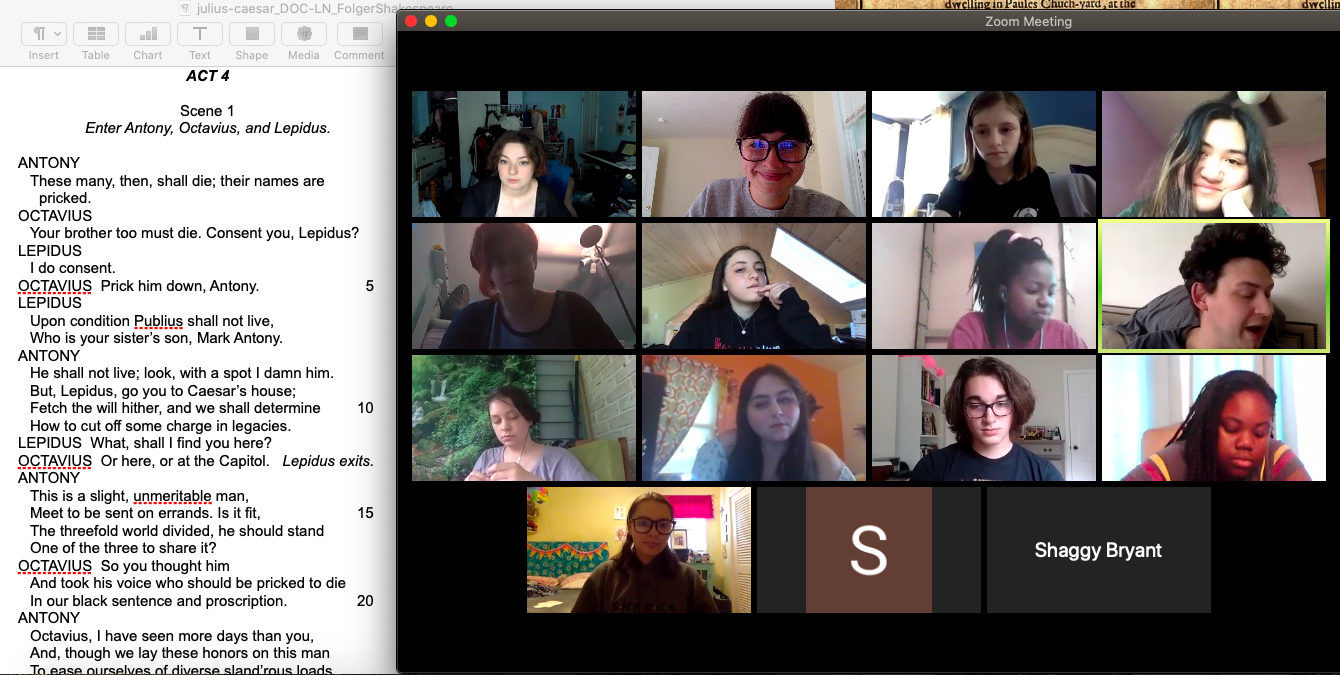
“This was a super unique experience and I think the Caesar team handled it super well. Our process was super collaborative and I know for a fact that my ideas were heard.” — #SHXCamper
“Oh my gosh. Being in All’s Well with Lauren was incredible!!! She was the best director ever. I loved how we all got to come up with ideas ourselves as well as execute her amazing ideas. The creative freedom she gave us definitely helped get more in touch with character!!” — #SHXCamper
This was hard. We love what we do, and we had a hard time letting it go lightly. ASCTC, like ASC in general, has always been context-driven. What we do (mount one-hour productions of early modern plays) depends heavily not only on why (for live performance) but also on where (in the Blackfriars Playhouse) we do it. Even though we followed the same process of embracing our context to arrive at a final collaborative product, the #SHXCamp digital portfolios look nothing like the normal ASCTC performances — nor should they. After all, online is not the same as in-person.
2. USE THE DEVICE!
“I was surprised that I could make friends very effectively over Zoom!! I love everyone from camp so much.” — #SHXCamper
While I still spend a good chunk of each day lamenting what we can’t have on Zoom (eye contact, side conversations, ensemble work, unison vocal work, eye contact, eye contact, eye contact) what we can have on Zoom is nevertheless remarkable. Here are a few Zoom functions we used (or should have used) to great effect at #SHXCamp:
- Share screen
The digital equivalent of holding up a page for display or glancing (with permission) over your neighbor’s shoulder, screen sharing became second nature at #SHXCamp. Along with a simple view of the screen, Zoom makes it super easy for users to share more. You can send files through Zoom’s screen share function and write on a shared digital “white board” together (see item c. “Annotate” on this list for more about that). You can also share your computer audio — either by itself (perfect for playing music while still being able to see faces in gallery view; came in very handy for the Masquerade Ball and our many impromptu dance parties) or with a screen share (perfect for watching video clips together; came in very handy for Archive Movie Nights).
- Breakout rooms
The digital equivalent of dividing into smaller groups. Hosts can create, open, and assign meeting participants to breakout rooms at any time during a meeting. Co-hosts can float between breakout rooms, as well. I cannot imagine rehearsing any sort of ensemble piece without liberal use of the breakout room function for dividing up scene work and delegating to production team members. It’s easy to use, it significantly increases productivity by allowing you to work on more than one moment at a time, and it provides much-needed variety for participants (especially those who may thrive in smaller groups but be reluctant to engage in larger ones).
- Annotate

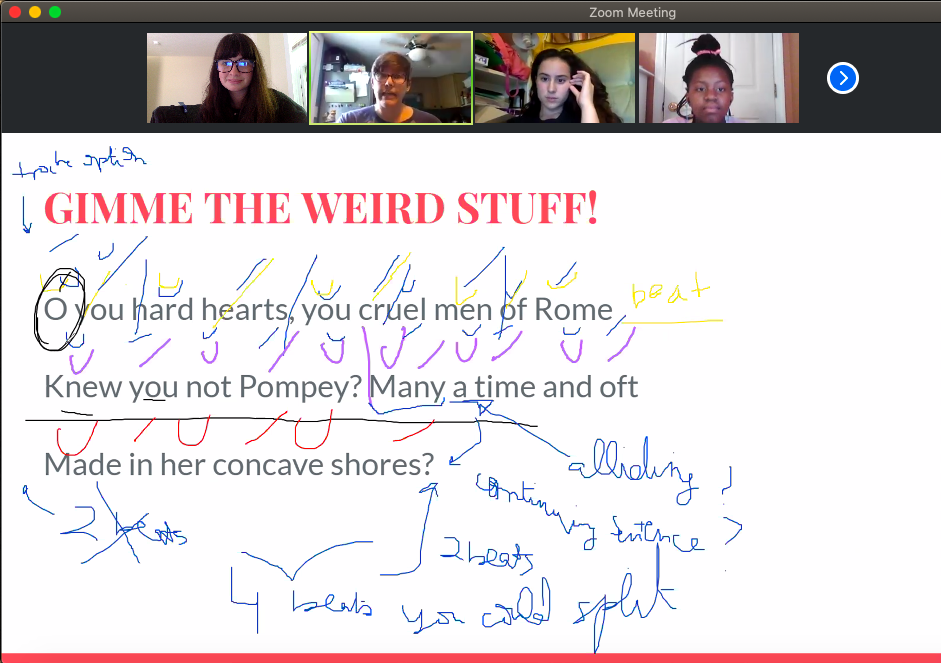
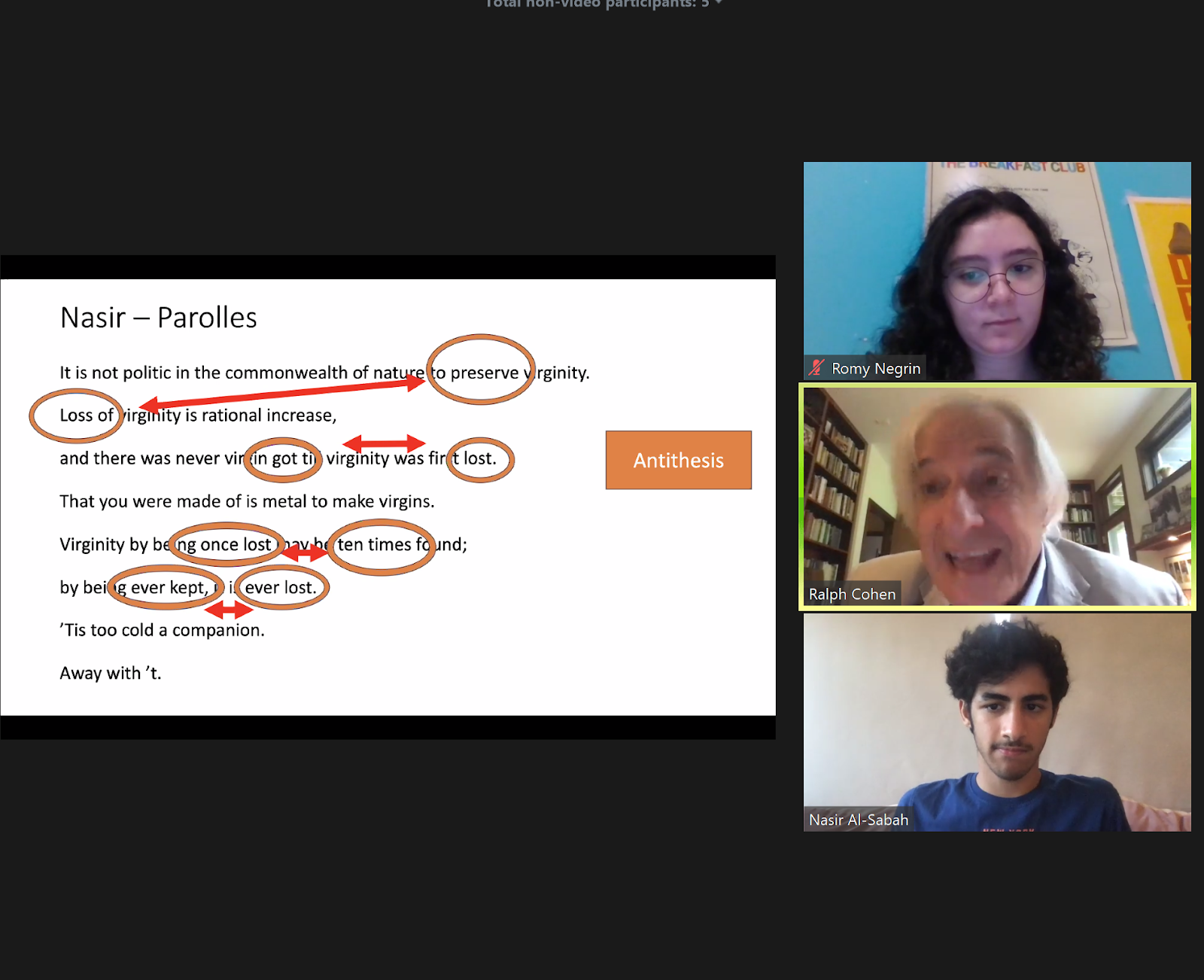
Hosts and meeting participants can use the “annotate” function to draw or write on a shared screen (or shared whiteboard). A simple way to engage students’ participation in workshops (especially since Zoom changed the default settings to automatically show the name of each annotater next to their contribution). We used this to mark up text in our rhetoric and scansion workshops, and also to doodle together between classes.
- Chat
“One of the big pluses of using Zoom is that you can private message people. When I can tell people are stressed out or they’re doing a big presentation or something, I normally drop them a “you can do it!” motivational message in their private Zoom messages! Many campers did this for me and the messages never failed to brighten my day.” – #SHXCamper
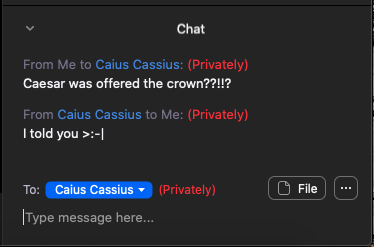
While I understand the gut reaction to stay away from chat features (we don’t encourage students to pass notes in class, after all) I want to encourage everyone to check their assumptions in this ridiculous time (and remember all the notes they passed in their own classes back in the day anyway). Connecting is hard when we are forcibly separate. Embrace anything that makes it easier. We set rules around the chat functions on each digital platform in different contexts (e.g. only use the Zoom chat for dramaturgy-related questions or comments during rehearsals and keep unrelated chatter to the appropriate Slack channel — read more about Slack in item #4), which helped keep distractions to a minimum while still encouraging campers to engage with the material together.
- Hide Self View
“Some days were a little harder but I could always turn off my camera and move around and feel better.” — #SHXCamper
Humans are not used to witnessing our own interactions, and anybody who’s sat across the table from a mirror knows how distracting it is to be forced to do so. We gave #SHXCampers the option of turning off their cameras as needed, which they universally appreciated, frequently used, and (probably) abused on occasion. While requiring cameras on is problematic (especially when it comes to issues of access and bandwidth), so was our solution of allowing them to be turned off at-will. Sometimes, we found ourselves speaking to a sea of black boxes, unsure of whether we were being understood or even heard, which was both frustrating and demoralizing. One happy medium exists in the “hide self view” option, which keeps your camera on but removes your video from your own personal Zoom display (so you aren’t staring at your own face) thereby cutting back on Zoom fatigue.
Once we stopped lamenting the loss of our in-person program and turned our attention to what we were able to do online, we found all sorts of tools waiting to be put to creative use. If you find yourself forced to teach virtually this year, don’t panic. Investigate your platform(s) thoroughly, and encourage your students to do the same. You may find more than you think.
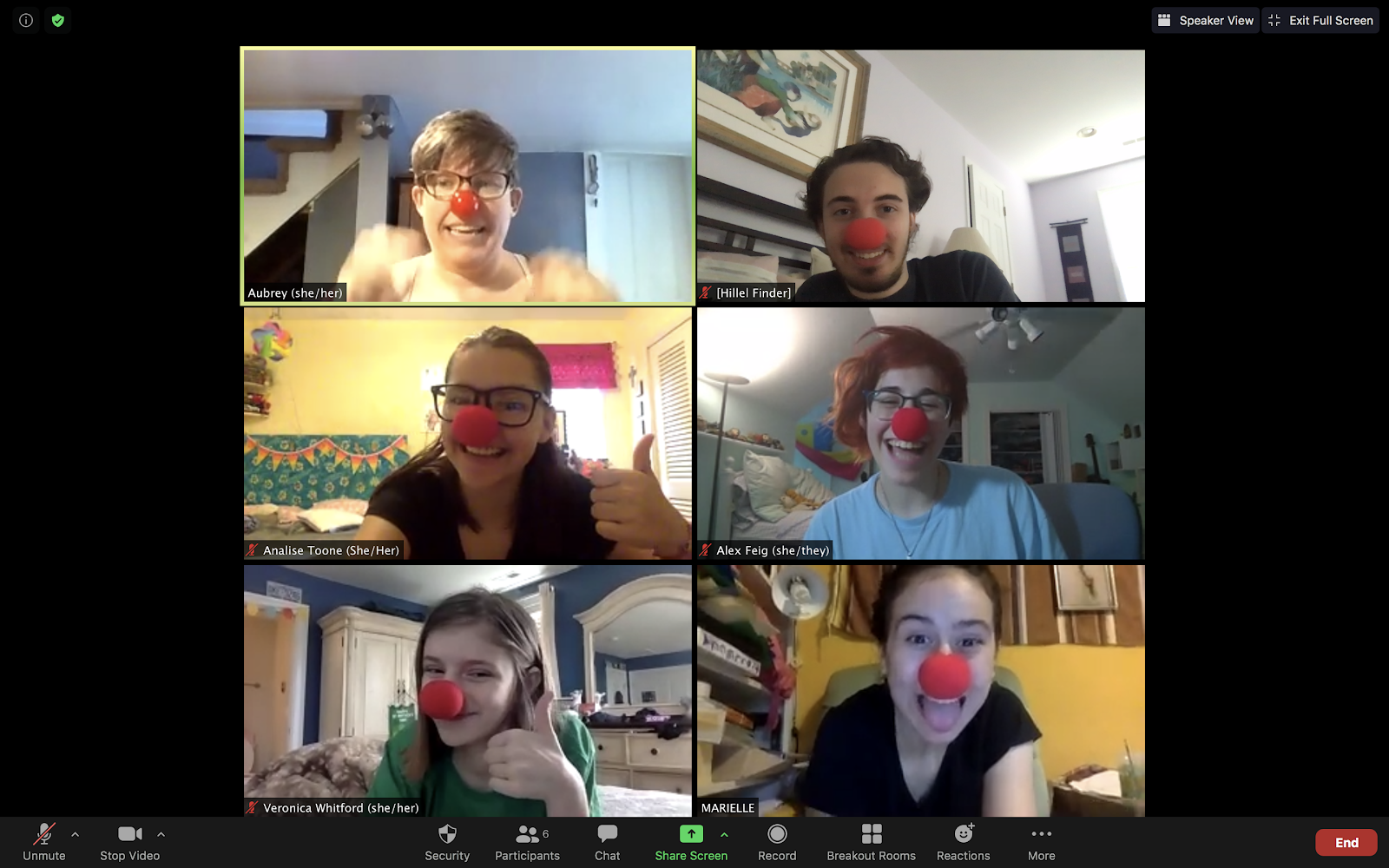
3. You will need more time to cover less material, and longer breaks to beat Zoom fatigue. Schedule accordingly.
“More breaks plz to cut some long zoom sessions. The zoom fatigue hits hard sometimes.” – #SHXCamper
Teaching over Zoom is different than teaching in person (see item #1 on this list). Not everything will take longer to do on Zoom, but a lot of things will — including the simple things many of us take for granted. For example, I used to be able to call on a student instantaneously with a simple visual scan and a social cue like pointing or eye contact, none of which is possible on Zoom. Instead, that instantaneous in-person action now takes long moments of verbal explication (instructing students to use the raise hand function, reminding them to unmute themselves, and dealing with the inevitable interruptions and miscommunications that arise from any confusion) to be virtually successful.
“I would have been ok with a longer day if it meant longer breaks in between things.” – #SHXCamper
In addition to the extra time it takes to do everything, our brains are scrambling to keep up with the constantly shifting modes of technological communication we now rely on but never evolved to use. Though advancements in technology outpaced biological evolution long ago, the struggle is still real and the cognition required for success is increasingly exhausting. There are ways to combat the resulting Zoom fatigue (see item 2e. “Hide Self View”) but the best remedy is thoughtful planning. Schedule brain breaks and take the time you need to be effective. Even if you end up covering less material in the short term, avoiding burnout will always get you further in the long run.
“I heard a lot of people talking about screen time and “zoom fatigue”, but that didn’t really affect me. I did school in the spring online from 9-2, so this really wasn’t that different — except that I was actually enjoying this, which made it much easier.” – #SHXCamper
4. Create a dedicated space for online socializing.
“I can’t believe how well you created a camp community experience. The first day online was exhausting and I wasn’t sure how all the hours online would translate into a 3 week experience, but it was amazing.” –#SHXCamp Parent
We realized back in March what many colleges and universities around the country began grappling with in July and August: when you lose the residential setting of your program, you lose the built-in immersion of the experience. The ASC Theatre Camp is about so much more than the content of its classes: it’s about the magic of meeting your people. That magic is not self-perpetuating. It needs time and tending, which it normally gets from the side conversations that happen while campers walk to classes together, the spontaneous board game tournaments in the dorm lounges, the late-night whispers between roommates, and all the other sorts of forced bonding that happen naturally between strangers thrown into a high-pressure, intensely emotional experience together. In order to make the magic happen online, we needed a way for campers to “hang out” during free time and connect during classes. Enter Slack.
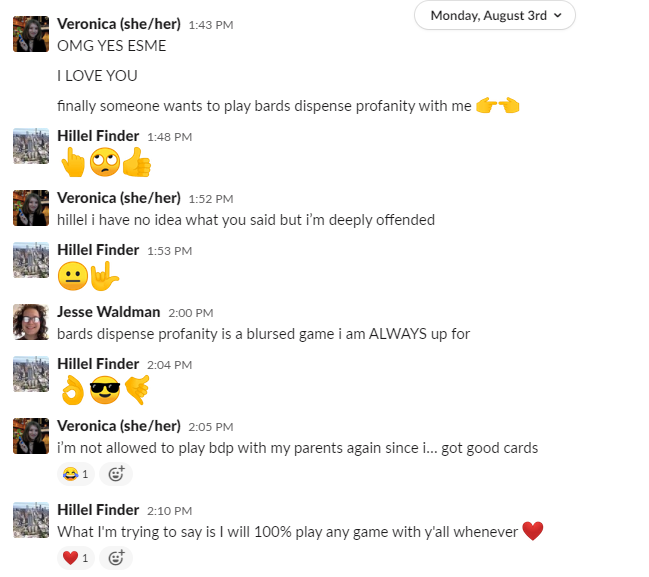
Slack is a “channel-based messaging system” designed for streamlining communications between coworkers, not a Learning Management System (LMS) designed for delivering content to students (like Canvas or Blackboard Collaborate). I do not work for Slack, and while I endorse the platform heartily, my point is not to convince you to buy it. But I cannot overstate the importance of having a unified, customizable, segmented communications platform for #SHXCamp alongside our Zoom rooms. Everybody had access to standard channels like “general” and “random” as well as #SHXCamp-specific custom channels like “tutorials and resources” (where we stored instructive files like workshop handouts and demo videos) and “antiracism” (where we compiled information about actively dismantling white supremacy). Specific groups within the #SHXCamp workspace could also access private channels for specific projects or conversations — each cast had its own private channel for discussions related to their digital portfolios, for example. In addition to the private and public chat channels, Slack also allows all members to send direct messages to anybody else in the workspace. These features gave us all the ability to quickly and easily connect with everyone from anywhere, and allowed the inside jokes and “had to be there” moments of camp to happen online.
“If I had to pick one thing [I’ll still remember 20 years from now] though, it’s definitely the friends I made. Because I can confidently say that I made 18 new friends in the middle of a pandemic, and that’s pretty darn cool.” — #SHXCamper
While it took us about a week to get the hang of it (not an insubstantial amount of time in a three-week program), the #SHXCamp Slack workspace became a thriving digital community so vibrant and effective that we decided to keep it forever. We’re creating a SHXSlack subscription benefit for all current and former ASC Theatre Campers (and Camp staff) who join the Epizeuxis Society of ASC donors, which will give them access to this exclusive bubble of Camp resources, events, and friends. We weren’t sure it would work, but it absolutely did — and now we can all keep Camp in our back pockets year-round.
5. We can do this. Together.
“Wow. I cannot say enough amazing things about this camp. I had no expectation that a true residential camp experience could be duplicated, but y’all have absolutely done it. [My camper] has lived and breathed #ShxCamp. It has inspired her beyond measure and surrounded her with a community of passionate people… something she didn’t even know she needed. It has most definitely impacted where she’s considering attending college and even her career plans. She’s already planning for next summer, and I NEVER imagined I would have her considering leaving home for a camp for 3 weeks. Every piece of this camp has been enjoyable for her, and you truly built a community. She’s going to have the same post-camp withdrawals she would if she’d been there in person. I’m mind-blown that a virtual experience could do that, and so thankful that you pivoted this camp to online.” — #SHXCamp Parent
Camp is magic. I learn that anew every summer, and 2020 was no exception. No matter where or how we do it, bringing together a bunch of enthusiastic young weirdos to explore and perform these centuries-old texts is magic. While I hope we never have to do a digital version of the ASC Theatre Camp again, knowing that we can do it is astonishing — and comforting. Weathering the uncertainties of our reality is difficult, and weathering them alone is nigh impossible. At the end of the day, we are what will get us all through this. Each other.
“Thank you so much for saving me from my darkest moments.” — #SHXCamper
Loneliness is corrosive and deadly. I cannot speak for anyone else, but I know I have felt lonelier in the last 5 months than I had in the previous 5 years. But for three weeks this summer, I never felt alone — because I never was. I had Camp with me.
The article above was authored by Lia Wallace, the Camp Director & College Prep Programs Manager of American Shakespeare Center Theatre Camp
The views and opinions expressed in the article above are those of the author and do not necessarily reflect the official policy or position of Camp Channel, Inc.
This article has been published to provide a first-hand account of one camp’s efforts and experience operating in the midst of Covid-19 during the summer of 2020; for the benefit of camp families, camp professionals, and the public at large. What may “work” for one camp might not for another. We believe safety is of paramount importance and urge those seeking to attend a camp in 2021 use due diligence and contact a camp directly about their systems, protocols, and outcomes. Originally published November 2020. This article reflects the experiences of one camp program during the Covid-19 pandemic and is preserved here as a first-hand account of virtual camp programming.
This post is part of the Camp Types and Programs guide on Camp Channel.
Search Summer Camp Guide

Music Camps: How to Find the Right Program by Genre, Instrument, or Ensemble
Music camps serve a wide range of ages, skill levels, and musical interests, from beginners picking up an instrument for the first time to advanced students preparing for conservatory auditions. Finding the right program means understanding how music camps differ in their structure, focus, and format, and knowing how to match those variables to a specific student’s goals.
Types of music camps
Most music camps organize their programs around one or more of three primary dimensions: genre, instrument, and ensemble format. A camp focused on jazz improvisation serves a different student than one focused on classical strings or musical theater performance, even if both call themselves music camps. Understanding which dimension matters most for a given student is the starting point for an effective search.
Genre-focused camps center their curriculum on a specific musical tradition. Classical, jazz, blues, rock, bluegrass, electronic, country, and musical theater are all represented in the CampChannel.com music camp directory. Jazz camps in particular tend to emphasize improvisation, ensemble playing, and music theory alongside instrument instruction. Classical programs often include ensemble rehearsals, individual lessons, chamber music, and weekly concerts or recitals.
Instrument-specific programs concentrate on developing technique and repertoire for a particular instrument or voice type. The Camp Channel directory includes programs for guitar, piano, voice, woodwinds, violin, drums, bass, brass, strings, saxophone, harp, viola, cello, and digital instruments, as well as live sound engineering and production. Demand for instrument-specific programs varies: guitar, piano, and voice programs are the most numerous, while programs for less common instruments like harp or viola are more specialized and geographically concentrated.
Ensemble and theory programs focus on the experience of playing with other musicians rather than individual instrument development. Bands, orchestras, chamber ensembles, jazz combos, choirs, and composition workshops all fall into this category. These programs are particularly valuable for students who already have solid individual technique and want to develop the collaborative and listening skills that ensemble playing requires.
Residential versus day camp formats
Music camps are available in both residential overnight and day formats. Residential programs, where students live on site for the duration of the session, are common among conservatory-affiliated programs and those held at college campuses or dedicated performing arts facilities. They typically offer more immersive instruction, evening performances, and a peer community of musicians that extends beyond the formal curriculum. Day programs are more accessible geographically and cost-effectively, and many offer the same quality of instruction in a non-residential setting.
CampChannel.com lists music camps across 35 states and two Canadian provinces, with the highest concentrations in California, New York, Pennsylvania, Texas, and Florida. Programs range from single-day workshops to multi-week residential sessions.
What to look for when evaluating a music camp
Skill level requirements vary significantly among programs. Some camps are designed for beginners with no prior experience; others require audition recordings or minimum years of study for admission. Confirming skill level expectations before applying saves time and prevents mismatches. Age range is similarly important: programs designed for middle school students are structured differently than those serving high school or adult musicians.
Faculty credentials and student-to-instructor ratios are worth examining directly. Programs affiliated with universities, conservatories, or professional performing organizations tend to provide access to working professional musicians as instructors, which is particularly valuable for students interested in pursuing music seriously. The presence of master classes, guest artist performances, and recording opportunities are additional signals of program depth.
Find music camps on Camp Channel
The Camp Channel music camps directory allows you to search by genre, instrument, ensemble type, and state. Browse programs by focus area including classical, jazz, rock, musical theater, and more, or search by instrument from guitar and piano to strings and brass. For deeper guidance on choosing the right program, see our guide to selecting an appropriate music camp. Camp directors offering music programs can add or update a listing on Camp Channel to reach families searching for programs in your specialty.
This post is part of the Camp Types and Programs guide on Camp Channel.
Search Summer Camp Guide
10 Questions To Ask When Taking a Summer Camp Tour
One of the best things you can do as you choose a camp is to schedule a tour. America’s best summer camps realize the value of these personal visits and will encourage you to see the camp and meet some of the staff.
I have conducted hundreds of camp tours for campers and families over the past 30 years. There are certain things I know the kids especially want to see and understand to relieve potential anxiety. I also know that parents have important things they want to know too. If you are a first time camp family (especially overnight camp where there are a lot of new things you haven’t even thought of yet) it can be hard to get all the information you want on a tour. So here are my Top Ten questions you should ask before, during, or after the camp tour. I absolutely recommend a camp tour before sending your child to a camp. Think ahead. If you are interested in a camp that is inaccessible part of the year because of snow or other weather conditions, you may need to take a tour the summer before you plan to enroll.
- Where will I sleep, shower, and go to the bathroom? These are the number one concerns of a young camper on a camp tour. Trust me, they are excited by the climbing wall and swimming pool but make sure you see the cabins and bathrooms. I have seen anxious campers melt with big smiles once they can climb on a bunk bed, make sure the bathroom is not smelly (or too far away) and realize there is a place to shower. A great follow up question if the camp has bunk beds (most do) is “how do you decide who sleeps on which bunk?” Some kids are very anxious about a top or bottom bunk and knowing how that will be assigned is comforting information.
- Where and what will I eat? Super important for kids to understand where the food comes from. They worry about this stuff but may lack the foresight to ask the question. So, ask it for them. After all, Moms and Dads want to know this stuff too.
- How do parents and campers communicate? Ask the Camp Director this question with your campers present and listening. As a parent it is very important that you support the camp communication policy. And, it is important for your child to understand that communication will probably be limited. It is also a great way to make it real for them that they will be handling this experience by themselves without calling or messaging you every 5 minutes.
- Where do your campers come from? There is no right answer to this question but it is an important one to ask. First, it gives you a very good idea that the Camp Director or person giving the tour has a handle on who they serve. It also allows you to focus in on the camp environment you want your child to be a part of. Do you want your camper to have camp friends that he/she/they can see throughout the year? In that case a camp with a strong local presence is important. Want to increase your child’s world view and understanding of other cultures? Campers and staff from around the world can provide awesome insight into life in other countries.
- Can you show us where a camper can go if they need help? I love it when people ask this question (and if they don’t I answer it anyway.) For many campers, Summer Camp is new and a bit intimidating despite all the fun and energy. So having a visual reference of the office, health center, or wherever they can go when they need guidance is very helpful. I notice that the kids I can remember meeting on a tour are much more comfortable walking into the office with questions. They know it’s okay to walk through that door because they have already done it.
- How does the weather today compare to a typical summer day. Many campers may not understand temperature as a number of degrees but can will certainly understand “Cooler, warmer, or about the same.” It is important that you and your camper prepare for the climate at camp and this question, asked on a tour, makes it easy to understand.
- Are you accredited by the American Camp Association (ACA?) There are two reasons to ask this question. 1) ACA is the only nationally recognized accreditation body for camps. So if a camp is ACA accredited they have chosen to pursue a very high level of standards for their camp programs. 2) This is a bit sneaky but asking this question sets you apart as a person that has really done the homework. The fact that you mention ACA will get the Camp Director’s attention. They may pay just a little bit more attention to your needs on the tour because they recognize you as a savvy customer.
- Do you have any materials we can take home? Many camps no longer mail a brochure home but rely on their websites to convey the feel and philosophy of their camp. But most camp offices are filled with swag! Your campers will feel special if they have a sticker, comic book, or giveaway item that isn’t widely available. You should get something special because you came for a tour, right?
- What’s one thing my camper should bring that’s not on the packing list? Every camp I have ever visited or gotten to know has a packing list. And, they all have this kind of secret menu of items that returning campers and staff know about but first time campers couldn’t possible know. At one camp I visited it was glow sticks (for night hikes) and at another it was laundry detergent to add to your own bag of dirty clothes on Wash day because the camp never seemed to use enough. Nobody was trying to keep these things secret from new kids but nobody thought to add them to the packing list. By the way, if you were to ask me that question on a tour I would say “Ping Pong balls!” We sell thousands of boring white ping pong balls in our store for a nickel each (Comes out of the kids camp store account.) So save your camp money and stand out from the crowd with orange or colored ping pong balls. You will also save your spot at the table when you don’t have to run to the store for a new ping pong ball. (Ping Pong is very popular at our camp. We have 6 tables!)
- Finally, one for Moms and Dads: Can we see your kitchen? Food is very important and seeing where it is made and served is a nice touch. But seeing how clean the kitchen is, how well organized and fresh smelling it is, tells you the camp pays attention to details. They didn’t just clean the areas you were about to see but they make sure the camp is safe and clean at all times.
So there we have it. Ten questions to ask on your camp tour. And, please make sure you do schedule a camp tour if you possibly can. It will make you and your camper feel much more prepared for the adventure ahead.
Andrew Townsend is the Director of Kennolyn Camps, based in Santa Cruz, CA. Kennolyn offers overnight camps in Santa Cruz and on Huntington Lake as well as Day Camp and Family Camp. Kennolyn has been a Bay Area favorite since 1946. Kennolyn is accredited by the American Camp Association. www.kennolyncamps.com 831 479 6714.
This post is part of the Choosing a Summer Camp guide on Camp Channel.

Camp Facility Rentals: An Alternative Venue for Groups and a Revenue Option for Directors
Summer camp facilities sit largely unused for eight or nine months of every year. During that window, many camps rent their grounds, cabins, dining halls, and activity spaces to outside groups seeking an event venue unlike anything a hotel or conference center can offer. The result is a market that serves two distinct audiences: groups looking for immersive off-site venues, and camp directors looking to offset the costs of maintaining year-round facilities.
Who rents camp facilities
The range of groups that book camp facilities for rentals is broader than most people expect. Common event types include:
- Corporate retreats and team-building programs
- Religious retreats and gatherings
- Family reunions and multi-generational group events
- Weddings and outdoor ceremonies
- Sports training camps and athletic programs
- Educational programs, workshops, and seminars
- Youth organization events outside of a summer camp context
What these events share is a need for a self-contained setting where the entire group can eat, sleep, meet, and participate in activities without leaving the property. Camp facilities are purpose-built for exactly that kind of immersive group experience, which is why they work so well for event types that conventional venues struggle to accommodate.
What camp facilities typically offer
Across the CampRentalChannel.com directory, 95% of listed facilities have overnight lodging, 95% have dining facilities, 86% have conference or event meeting space, and 85% have waterfront access. That combination is genuinely difficult to replicate in a standard hotel or event center, and it is what makes camp rentals particularly attractive for multi-day events where keeping the group together on-site is a priority.
Facilities vary considerably in capacity and configuration. Some are suited to intimate gatherings of under 50 guests; others can accommodate groups of several hundred or more. The best fit depends on your group size, event type, and the specific amenities you need. Seasonal availability is another variable worth understanding early: most camp facilities are unavailable during their primary summer season and rent during spring, fall, and in some cases winter, with year-round availability more common in mild-climate states like California and Virginia.
For camp directors: rentals as an off-season revenue stream
For directors managing facilities that sit largely idle outside the summer season, group rentals represent a meaningful and relatively low-friction revenue opportunity. The infrastructure required to host campers, including cabins, dining halls, kitchen facilities, and activity spaces, is the same infrastructure that outside groups need for their events. Listing a facility on CampRentalChannel.com connects it with groups actively searching for exactly what most camps already have.
Directors considering facility rentals should think through staffing requirements for off-season events, insurance and liability considerations for outside groups, and how rental bookings interact with any shoulder-season programming already on the calendar. The CampRentalChannel.com directory provides a straightforward way to make a facility visible to the groups searching for rental venues without requiring significant marketing investment.
Find camp rental facilities
The CampRentalChannel.com directory lists camp rental facilities across the United States and Canada, with profiles covering capacity, amenities, seasonal availability, and direct contact information. For a detailed guide on evaluating facilities and what to ask before booking, see Questions to Ask Before Renting a Camp Facility for Your Group Event on the CampRentalChannel.com resources blog. Camp directors interested in listing a facility can visit CampRentalChannel.com/directors to add or update a listing.
This post is part of the Camp Types and Programs guide on Camp Channel.
Search Summer Camp Guide

National Parks & Summer Camps: Essential Sanctuaries in the Modern World
August 25, 2016 marked the National Park Service’s Centennial, its 100th anniversary. Some might say the National Park system is our nation’s best idea, for a great number of reasons; some of the most poignant of which cannot be easily translated into mere words as a substitute for one’s presence amidst the sublime natural surroundings National Parks afford to those who cross their often frail boundaries into the unique ancient landscapes and habitats contained therein.
A long range historical perspective might reveal how the establishment of the National Park Service represented an effort to not only preserve our natural treasures, but to establish a foundation and cooperative framework to afford what might be considered the equivalent of large scale communal camp facilities for generations to engage and establish connections in perpetuity, amidst a contemporary world which often bombards us with a constant stream of trivial information and unending artificial stimuli.
Just as National Parks provide a physical venue for people to come together and perhaps form unseen yet enduring bonds with untrammeled natural landscapes and wildlife, summer camps might be thought of in a similar light in so far as providing a sanctuary from some of the more obtrusive aspects of modern life which might affect young people’s ability to better engage in meaningful social interaction and relationships with other individuals at a formative age.
As the sprawl of modern life has enveloped much of our natural surroundings, perhaps so too have technological advancements encumbered relationships among people, young and old. As a society and as individuals, we have generally drifted further and further into the individualized compartments of virtual worlds, electronic devices, and gadgetry; often at the expense of establishing and developing meaningful bonds with others in real time, in person.
Summer camps offer a forum for kids to establish real life relationships with one another; many of whom are experiencing similar issues in navigating the complicated waters of modern life. A camp environment may facilitate more thoughtful conversation and interaction with others in the moment versus the often caricatured reclusive behavior of reflexively retreating to one’s mobile device.
In a similar light as National Parks, some camps are able to provide a direct connection to our natural environment at various levels of immersion. Given the apparent decreasing scope of nature from our collective consciousness, the value of such a portal is immense; even as a simple reminder to all of us regarding our essence as human beings and what ultimately sustains us as creatures who inhabit the Earth.
Summer camps come in all shapes and sizes with respect to locale, facilities, and programming emphasis. Not all camps take place outdoors in a natural setting; however, even camps that utilize an indoor facility still offer a meaningful venue to congregate and interact with others in a positive fashion.
It is difficult to refute how technology has improved the human condition, offering tremendous breakthroughs and conveniences on a number of fronts. However, without the adoption and nourishment of constructs pertaining to real life bonds and relationships to people and the natural environment, technological improvements will invariably not live up to their potential to help people prosper; instead perhaps serving to perpetuate and amplify disconnects between people and nature alike.
Parallel origins: a shared history
The National Park Service and summer camps also share the same general historical era with respect to some of their early implementations. Theodore Roosevelt, the 26th President of the United States, extended federal protection to an unprecedented amount of land and wildlife during his terms in office from 1901 to 1909, including five National Parks, eighteen National Monuments, and the beginning of the United States Forest Service, totaling nearly 250 million acres. It was on the heels of the Roosevelt administration that the National Park Service formally sprang into existence in 1916.
During the same approximate time frame, the first traditional residential summer camps in the United States began to appear in the early part of the 20th century. Several of those original camps are still in operation today:
- Awosting (founded 1900)
- YMCA Camp Mason (founded 1900)
- Frost Valley YMCA (founded 1901)
- Surprise Lake Camp (founded 1902)
- Camp Highlands for Boys (founded 1904)
- Pok-O-MacCready Camps (founded 1905)
- YMCA Camp Lakewood (founded 1905)
- Camp O-AT-KA (founded 1906)
- YMCA Camp Copneconic (founded 1915)
- Fairview Lake YMCA Camps (founded 1915)
- Keystone Camp (founded 1916)
For well over 100 years, enrollment in summer camp programs has been strong and durable; helping to provide children growing up in the midst of unbelievable technological advancements the essential tools for establishing and improving interpersonal dynamics at a young age, holding great promise that such experiences can be imparted from one generation to the next in the years to come.
National Parks have similarly been a tremendous success, with an ever increasing number of park visitors from year to year. Even in spite of the potential detrimental impact to park infrastructure from high visitor usage, it is a heartening sign in a contemporary life filled with distractions to see our National Parks being visited in such great numbers, representing perhaps the heartbeat of a society trying to maintain its way in a quickly changing and fast paced world.
This post is part of the Camp Types and Programs guide on Camp Channel.
Search Summer Camp Guide


